The Hidden Price Tag: Environmental Liabilities That Can Turn a Land Deal Upside Down
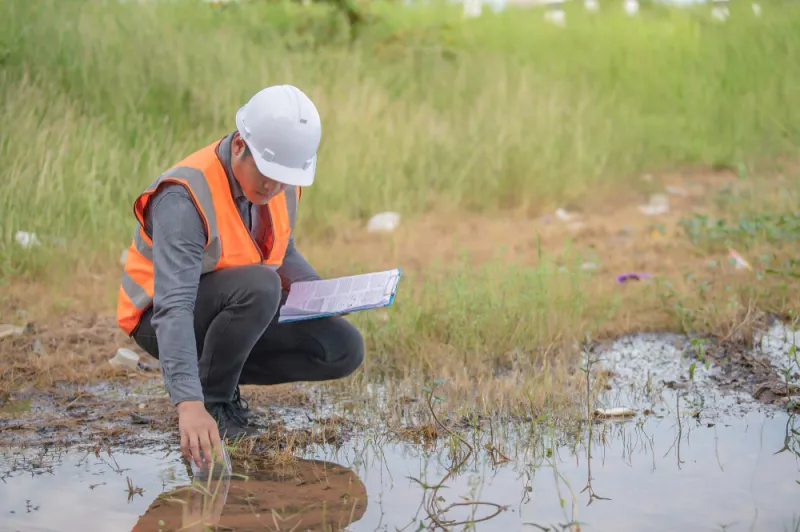
Photo: environmental assessment wetland land contamination soil testing field, via www.rogerslandworks.com
A parcel of land priced below comparable listings in the same county can feel like a discovery. It may well be. It may also be priced where it is for reasons that are not immediately visible from the road, the aerial photograph, or the county assessor's database. Environmental liabilities represent one of the most financially consequential categories of hidden risk in land acquisition—and one of the least understood by buyers entering the market without professional guidance.
The range of environmental issues that can affect raw and transitional land is broader than most buyers anticipate, and the regulatory frameworks governing them are layered across federal, state, and local jurisdictions. Navigating this landscape before committing to a purchase is not merely prudent—it is, in many cases, the difference between a productive investment and a years-long remediation project.
The Spectrum of Environmental Risk
Environmental liabilities affecting land fall into several broad categories, each carrying its own regulatory implications and remediation cost profile.
Contamination from prior use is perhaps the most widely recognized risk. Land with a history of industrial activity, agricultural chemical storage, dry-cleaning operations, or fuel storage may harbor soil or groundwater contamination that triggers liability under the federal Comprehensive Environmental Response, Compensation, and Liability Act—commonly known as CERCLA or Superfund. Under this statute, liability can attach to current landowners regardless of whether they caused the contamination. This is not a theoretical concern: buyers who acquire contaminated land without conducting adequate due diligence have faced cleanup costs ranging from tens of thousands to millions of dollars.
Wetlands and jurisdictional waters present a distinct category of constraint. The Clean Water Act, administered by the U.S. Army Corps of Engineers in coordination with the Environmental Protection Agency, regulates development activities in and around wetlands and waters of the United States. Filling, grading, or constructing on regulated wetlands without a Section 404 permit can result in enforcement actions, mandatory restoration requirements, and substantial civil penalties. Critically, the presence of jurisdictional wetlands may not be obvious to the untrained eye—seasonal wet areas, certain vegetation communities, and hydric soils can indicate wetland conditions even on land that appears dry during most of the year.
Endangered and threatened species habitat represents a third category that has derailed development plans across the country. The Endangered Species Act requires federal agencies to consult on actions that may affect listed species, and its provisions can effectively prohibit or severely constrain development on land that supports protected wildlife or plant communities. Buyers targeting land for residential subdivision, commercial development, or large-scale agricultural conversion should investigate whether known species or critical habitat designations apply to the subject parcel or its vicinity.
Floodplain designations compound environmental risk with regulatory complexity. Parcels within FEMA-designated Special Flood Hazard Areas face restrictions on development, mandatory flood insurance requirements, and the practical challenge of constructing improvements that meet base flood elevation standards. In some cases, floodplain designation substantially limits the usable acreage of an otherwise attractive parcel.
Phase I and Phase II Environmental Assessments: What They Cover and When You Need Them
The environmental assessment process provides buyers with a structured methodology for identifying and evaluating these risks before closing. The industry standard framework, established by ASTM International and widely recognized by lenders, regulators, and courts, involves two primary phases.
A Phase I Environmental Site Assessment is a records review and site reconnaissance process conducted by a qualified environmental professional. It examines the current and historical uses of a property and its surrounding area, reviews regulatory databases for known contamination sites and compliance violations, and identifies recognized environmental conditions—defined as the presence or likely presence of hazardous substances or petroleum products that could affect the property. A Phase I does not involve sampling or laboratory analysis; it is an investigative and documentary exercise.
When a Phase I identifies recognized environmental conditions that warrant further investigation, a Phase II Environmental Site Assessment is the appropriate next step. Phase II work involves physical sampling of soil, groundwater, or building materials to determine whether contamination is actually present and, if so, at what concentrations. The results of a Phase II assessment establish the factual basis for remediation planning, cost estimation, and liability negotiation.
For commercial and industrial land acquisitions, lenders will typically require at minimum a Phase I assessment as a condition of financing. For buyers pursuing raw land with agricultural or light industrial history, commissioning a Phase I independently—regardless of lender requirements—represents a sound use of due diligence resources.
Federal and State Regulatory Considerations by Region
Environmental risk is not distributed uniformly across the United States. Regional geography, land use history, and state regulatory frameworks create meaningfully different risk profiles in different parts of the country.
In the Southeast and Gulf Coast states, wetland complexity is particularly pronounced. States such as Florida, Louisiana, and South Carolina contain extensive jurisdictional wetland systems, and the interplay between federal Clean Water Act jurisdiction and state-level environmental permitting can add significant time and cost to development approvals.
In the Midwest and Great Plains, legacy agricultural chemical use—including fertilizers, pesticides, and fuel storage associated with farming operations—is a common source of soil and groundwater contamination. Buyers acquiring former farmsteads, grain elevator sites, or properties with visible above-ground storage tanks should treat these as recognized environmental conditions warranting further investigation.
In the Mountain West and Southwest, mining heritage creates contamination risk that extends well beyond the boundaries of the mine site itself. Acid mine drainage, heavy metal soil contamination, and legacy waste piles can affect downstream and adjacent properties. Additionally, water rights and water quality in arid regions carry their own regulatory complexity.
In Northeastern states, industrial legacy contamination is widespread given the region's manufacturing history, and state environmental agencies in states such as Massachusetts, New Jersey, and New York operate robust—and demanding—voluntary cleanup and brownfield redevelopment programs that buyers should understand before acquiring affected parcels.
Negotiating Environmental Liability with Sellers
Discovering environmental risk during due diligence does not necessarily mean walking away from a transaction. In many cases, environmental conditions can be addressed through negotiated contractual protections that allocate risk between buyer and seller in a manner that makes the deal viable.
Common negotiating strategies include: requiring the seller to remediate identified contamination prior to closing; adjusting the purchase price to reflect the estimated cost of remediation; obtaining environmental indemnification provisions in which the seller accepts ongoing liability for pre-existing conditions; and requiring the seller to purchase environmental liability insurance as a condition of closing.
Buyers should also be aware of state voluntary cleanup programs, which in many jurisdictions provide regulatory certainty and liability protection to parties who remediate contaminated sites to applicable standards. These programs can make otherwise stigmatized properties viable for acquisition and redevelopment.
The Cost of Skipping the Assessment
The environmental due diligence process carries a cost. A Phase I assessment typically ranges from $1,500 to $4,000 depending on property size and complexity. A Phase II can range from $5,000 to $50,000 or more depending on the scope of sampling required. These are not trivial expenditures.
They are, however, modest relative to the cost of discovering post-closing that a property requires remediation, that development plans must be redesigned around wetland constraints, or that a protected species habitat designation renders a subdivision economically unviable. Environmental surprises do not respect purchase timelines or investment theses. They appear on their own schedule, typically at the most inconvenient possible moment.
At Lands99, we believe that the ground beneath a transaction is only as valuable as the clarity a buyer has about what they are actually acquiring. Environmental due diligence is not a bureaucratic formality—it is the mechanism by which informed buyers protect their capital, their timelines, and their right to use the land they purchase as they intend.